

DriveNets has completed a $410 million Series D financing round, with the likes of AMD backing the firm as it looks to compete with the networking big boys.
More than a decade on from its founding, the firm has now raised $1 billion in total capital and plans to use its latest cash injection to scale inventory for its growing AI fabric pipeline, while also expanding its heterogeneous AI infrastructure solutions.
Ciena backers Atreides Management and investment stalwarts Bessemer Venture Partners led DriveNets’ funding round, with AMD coming on board as a new backer, alongside Red Dot Capital and existing investors Pitango and D1 Capital Partners.
Founded in 2015, DriveNets emerged as a means to shake up the established players in the software-defined networking, taking a cloud-native approach to routing and connectivity. Among its early wins, the firm provided the core routing system for AT&T.

DriveNets wants to upend network cost structures
Market uncertainty is proving to be an opportunity
In recent years, DriveNets has pivoted toward AI infrastructure, using its networking expertise and distributed disaggregated chassis approach to improve connections between tens of thousands of GPUs.
Its Ethernet-based AI fabric is already used by hyperscalers, neoclouds, and large enterprises, but more recently, it’s shackled up with some of the biggest AI vendors to help tighten the integration between networking and compute in multi-vendor AI environments. Among those are new backers AMD, with the pair having recently penned a reference architecture to help cluster builders deploy AI infrastructures across scale-up, scale-out, scale-across, and frontend & storage networking. DriveNets is also working with Broadcom on similar GPU utilization boosting initiatives, while Dell and Supermicro are on board to aid go-to-market activities.
“The most expensive idle asset in the world right now is a GPU waiting on the network,” said Ido Susan, co-founder and CEO of DriveNets. “We’re applying a decade of high-performance networking expertise to enable our customers to achieve higher utilization, reduce cost per workload, and scale their AI operations efficiently –on any AI accelerator they choose.”
Now DriveNets has set its sights on heterogeneous AI infrastructure, where hardware like CPUs, GPUs, and custom ASICs from a variety of vendors are tightly coupled into a single system solely designed for AI processing tasks. The emergence of heterogeneous computing follows a realization that AI workloads demand more than mere GPU brute force, with the shift further fueled by supply chain complexities and a growing push from customers to bypass the pitfalls of vendor lock-in.
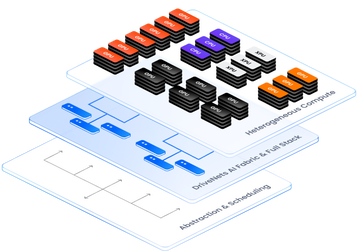
The firm argues its AI fabric can support heterogeneous environments owing to its ability to its apparent ability to perform full-stack optimizations for “any AI accelerator” in a cluster, thereby maximizing the performance and utilization of the entire cluster.
“AI infrastructure is entering a new era of open, integrated systems where compute, networking, and software scale together,” said Vamsi Boppana, AMD’s SVP for AI. “Our support of DriveNets’ Series D reflects a shared commitment to scaling AI workloads efficiently with AMD Instinct accelerators and DriveNets’ high-performance fabric on open infrastructure, advancing open, standards-based AI data centers.”
“Every shift in compute produces a new networking giant. Cisco wired the internet. Arista wired the cloud. Nvidia wired single-vendor AI. DriveNets is wiring what comes next: Heterogeneous AI,” said Adam Fisher, a partner at Bessemer Venture Partners. “This is why BVP led DriveNets’ $410 million Series D, an existing portfolio company we’ve backed since its Series A.”






Comments